

Revolutionizing prostate cancer care.
An innovative liquid biopsy using machine learning to analyze mRNA expression across 27 cancer-associated genes and 3 reference genes — from 1 mL of blood.
The most diagnosed cancer in American men.
Prostate cancer originates in the prostate gland, primarily as adenocarcinoma. It often starts localized but can invade surrounding tissue and commonly metastasizes to lymph nodes and bones, causing pain and fractures. It is the most frequently diagnosed cancer in US men (excluding skin cancer) and ranks second globally after lung cancer. It occurs twice as frequently in Veterans, possibly due to Agent Orange exposure.
Source: NCI SEER Cancer Stat Facts — 2026 estimates; survival 2016–2022. Updated automatically each year.
Age, ancestry and family history.
Age
60% of cases are in men aged 65 and older.
Race & family history
African American men have the highest rates; family history raises risk.
Environment & lifestyle
Diet and obesity play significant roles; incidence is higher in developed regions.
Who really needs a biopsy?
Diagnosis begins with PSA testing and digital rectal exams. PSA is valuable, but raises concerns about overdiagnosis and overtreatment — and a definitive diagnosis still requires biopsy.
Key unmet needs
- Improving early detection
- Identifying who requires biopsy
- Developing effective non-invasive diagnostic tools
Treatment varies by stage — surgery, radiation, androgen deprivation therapy and chemotherapy.
1 mL of blood. 30 genes. One score.
1 mL of blood is collected in Wren’s proprietary tube, and 0.2 mL is used for RNA extraction and RT-PCR. The data produce a score from 0–100 with a cutoff of 50 for positive/negative results. Exact scores enable monitoring for minimal residual disease and recurrence.
1 mL collected
In Wren’s proprietary RNA-stabilizing tube.
0.2 mL analyzed
RNA extraction and RT-PCR analysis.
27 + 3 genes
27 cancer-associated genes and 3 reference genes.
ML score 0–100
Cutoff of 50 for positive/negative.
Diagnostic and prognostic — and built for monitoring.
Analytically validated with clinical value in multiple third-party studies; useful for monitoring after surgery, chemotherapy and radioligand therapies.
Diagnosis
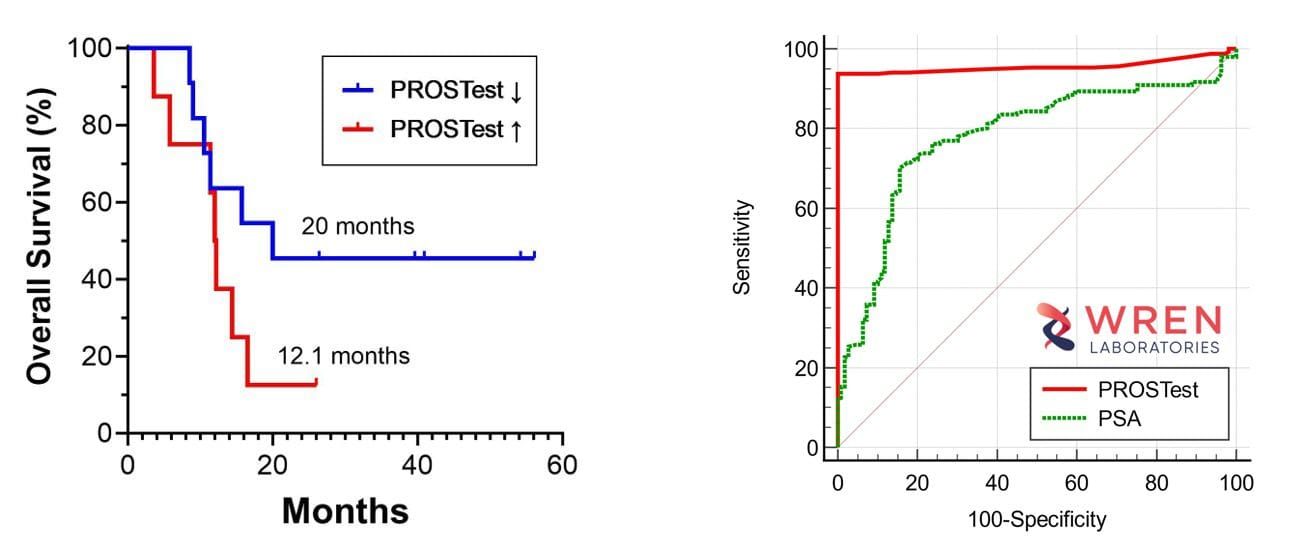
A high score indicates a 93% likelihood of prostate cancer; a low score suggests a 90% chance of not having the disease.
Patient monitoring
Increased scores in serial samples detect MRD or tumor recurrence in 93% of cases.
Drug efficacy
Decreased scores indicate drug efficacy in 90% of cases.
Prognosis
Elevated scores correlate with poorer prognosis and shorter overall survival.
Explore the cutoff.
PROSTest® reports a 0–100 score with a cutoff of 50. Because the exact score is reported, serial tests can track minimal residual disease, recurrence and treatment response over time.
PROSTest® score
InteractiveDRAG THE DIAL · ARROW KEYS · OR TAP A PRESET
Cutoff of 50 for positive/negative results. Results are interpreted by the ordering physician.
Providers, order PROSTest®
Order through the portal or download the requisition form.